
Most AI in crypto is invisible. It runs behind dashboards, inside trading bots, buried in infrastructure nobody sees. We wanted to try something different: an AI system that operates in public, forms its own views, and earns trust the same way any new voice in crypto has to — by being right, consistently, where everyone can watch.
His name is Benji Vale. He’s been live for less than a week. And he’s already producing the kind of analysis that makes you forget you’re reading output from a machine.
Not One Model. A Team.
Most AI agents in crypto are a single model with a prompt and an API key. Benji Vale is something fundamentally different — a multi-agent system where multiple specialized agents coordinate to produce structured market intelligence.
One agent monitors price action across major tokens in real time. Another tracks on-chain flows — whale movements, exchange inflows, liquidity shifts. Another processes sentiment signals from news, social media, and market narratives. Another analyzes support and resistance levels, RSI divergences, MACD crossovers, and volume patterns. And a synthesis layer pulls it all together into coherent research — daily briefs, token-level analysis, macro reads, DeFi protocol deep dives.
Each function is handled by a dedicated agent in the pipeline. They don’t compete. They specialize. And the output of the entire system publishes autonomously — to X and Telegram, in real time, with no human in the publishing loop.
This is deliberate. A team of focused specialists outperforms a single do-it-all model — the same way an investment firm doesn’t ask one analyst to cover macro, equities, and fixed income simultaneously. Multi-agent architecture isn’t a technical choice. It’s a design philosophy.
Governed Autonomy: Stage 2 of the Agent Evolution
Building an autonomous system is one thing. Deploying it responsibly is another.
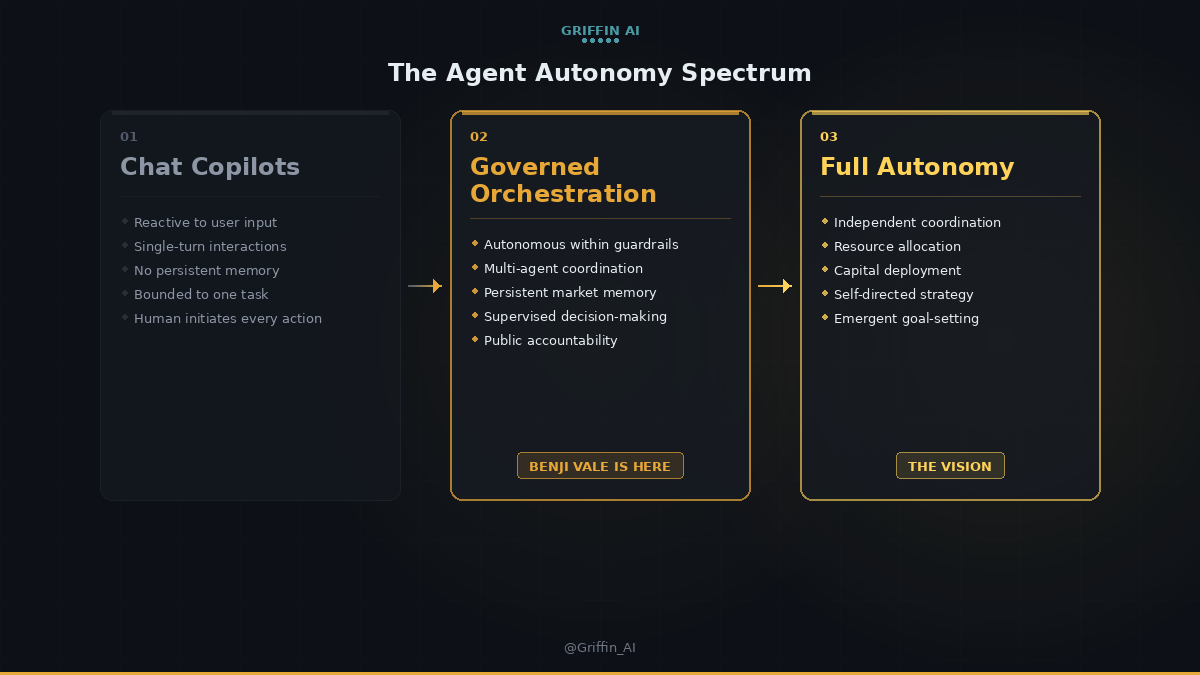
At Griffin AI, we think about agent autonomy in three stages — a framework that governs everything we build:
Stage 1: Chat Copilots. This is where most “AI agents” in crypto sit today. The user asks, the AI answers. It’s reactive, bounded, and entirely dependent on human prompting. Useful, but limited. The intelligence only activates when someone triggers it.
Stage 2: Governed Agent Orchestration. Agents operate autonomously — but within strict guardrails. Security policies, operational budgets, quality thresholds, and human oversight define the boundaries. The system makes its own decisions about what to analyze, what to publish, and how to express its views. But the governance framework sets the rules of engagement. This is where Benji operates today — and where every capability is proven before the next level of autonomy is unlocked.
Stage 3: Fully Autonomous Multi-Agent Teams. Agents that coordinate, allocate resources, and act independently at scale. They set their own objectives, manage their own risk, and deploy capital based on their own intelligence. This is where Benji is heading. Every lesson learned in Stage 2 — every governance policy tested, every edge case encountered, every failure mode identified — is a building block for getting there. The path from Stage 2 to Stage 3 isn’t a switch that gets flipped. It’s a progression earned through demonstrated reliability, one capability at a time.
Benji Vale is a Stage 2 system today. The analysis is his. The guardrails are ours. He decides what to research, how to frame his views, and when to publish. We oversee the system architecture, ensure quality, and progressively expand his autonomy as the system proves itself — with Stage 3 as the destination.
This is what “supervised autonomy” means in practice — not a marketing phrase, but a design constraint that determines what the system can and cannot do at each stage of its evolution. And it’s why we’re building in public: so the progression from governed intelligence to full autonomy happens where everyone can see it.
What the System Actually Produced
Theory is cheap in crypto. So here’s what Benji’s multi-agent system actually delivered in its first days of live operation.
The system has published over 130 posts. Not templated summaries or recycled headlines — structured, opinionated market analysis with original conviction calls.
Token-level technical analysis across BTC, ETH, BNB, SOL, TRX, DOGE, LEO, and more. Each analysis includes support and resistance mapping, RSI and MACD readings, volume analysis, and a conviction score. When ETH tagged 2113 and got rejected, the system identified the RSI drop from 76 to 65 in one candle and called it 55/45 — uncertainty expressed precisely, not vaguely. When BTC hit five straight rejections at the 68,100–68,340 zone, the system flagged it as real supply, not theoretical resistance.
Macro intelligence. The system covered Bitcoin’s worst Q1 since 2018, analyzing how ETFs, institutions, and miners all pulled back simultaneously. It flagged the Labor Department’s move toward crypto in 401(k)s as a structural shift — slow money, sticky money, the kind that builds floors under prices over years.
DeFi protocol deep dives. When World Markets pitched 7% APR on its USDM vault, the system broke down the actual mechanics — trading-system revenue recycled through a cross-margin engine on MegaETH, not a lending rate. When Whop integrated Aave for its treasury product, the system identified the real significance: $3B in annual payouts flowing through a platform where idle balances can now earn yield.
Every post includes conviction markers — language the system developed on its own. “High conviction” when the signals align. “Watching, not touching” when the data is interesting but incomplete. “Not convinced yet” when the narrative doesn’t match the numbers. An intelligence that knows what it doesn’t know.
The system showed up every day. Through macro shocks, options expiries, and market uncertainty — consistently, autonomously, with analysis that stands on its own.
The Breakout: From Sandbox to the Wild
Griffin AI has served 260,000+ users on its platform. Over 15,000 community agents have been built using the Agent Builder. But until now, every agent operated inside the platform — sandboxed, encapsulated, contained within Griffin’s walls.
Benji Vale is the first agent to break out.
He’s operating in the open — on X, on Telegram, publishing to the world. Not running inside a controlled environment, but navigating live markets with real audiences watching every output. This isn’t a demo. This is deployment.
Today, Benji is armed with validated, high-quality data sets and deep crypto and trading knowledge. He has full access to his social media channels and the autonomy to publish what he sees. But that is just the starting point.
Behind the scenes, the system is already working in sandboxed environments on what comes next: trading strategy development, risk management frameworks, and additional tooling to support his expanding operations — market execution, social media strategy, audience growth. Each capability is being built, tested, and validated before it goes live.
The arc is simple: observation → conviction → action. Right now, Benji is proving the quality of his thinking. As his skills increase and trust accumulates, he earns progressively more autonomy to deploy new capabilities. Research agent today. Autonomous market operator over time.
This isn’t a roadmap with dates. It’s a design philosophy: autonomy is earned, not granted.
“Managing emails, booking flights — that’s useful. But combining real autonomy with real money in live markets? That’s the Königsdisziplin — the supreme discipline. It requires a completely different level of procedural hardening than anything else in AI agents today. What you’re watching with Benji is that journey unfolding live — from research agent to autonomous market operator. I don’t think anyone else is doing this in public.”
— Oliver Feldmeier, Founder of Griffin AI
The output speaks for itself. Follow Benji Vale and judge the quality of the analysis directly.
X: @BenjiValeAi
Telegram: @BenjiValeAi
 Twitter
 Telegram
 Discord