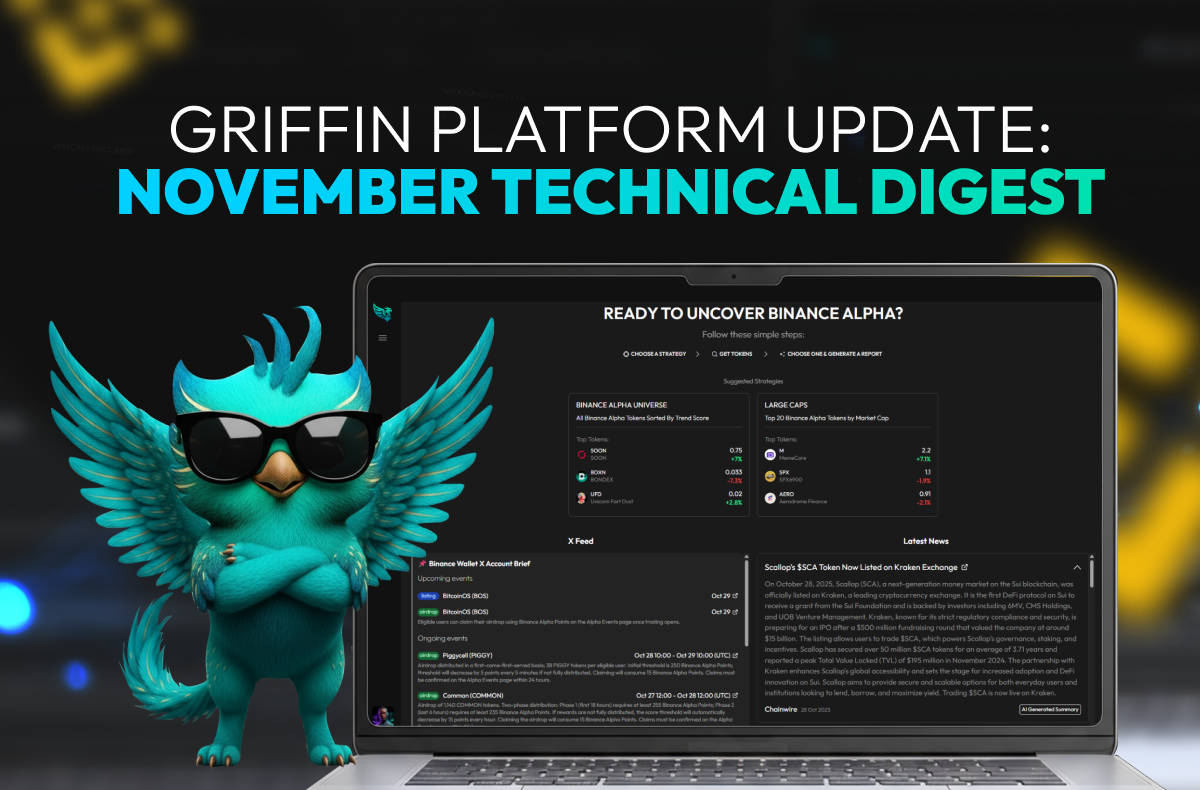
Griffin Platform Update: November Technical Digest
Cycle Focus: Infrastructure Hardening, Signal Fidelity, and Tiered Access Architecture
This report provides a technical retrospective on the updates, refactors, and major feature releases deployed throughout the recent engineering cycle.
While the visible highlights of this period were the launches of Griffin Premium and the Binance Alpha Agent, substantial engineering resources were allocated to strengthening the backend data ingestion pipelines and optimizing the frontend execution logic (TEA). These updates were rolled out across multiple maintenance windows and are now fully stable in production.
1. Major Architecture Releases
The October cycle marked the deployment of two foundational systems that restructure how users interact with the Griffin ecosystem.
Griffin Premium: On-Chain Permission Layer
We successfully deployed Griffin Premium v1, moving beyond traditional subscription databases to a trustless, token-gated permission architecture.
- Mechanism: The system executes a real-time query of the connected wallet’s on-chain GAIN balance.
- Threshold Logic: Access is granted/revoked instantaneously based on a ≥ 100 GAIN holding requirement.
- Compute Allocation: Premium users are migrated to a high-priority tier, increasing the daily operational credit cap from 150 to 250 credits to support high-load agent workflows.
- Access Gating: Advanced expert systems and heavy-duty agents are now logically gated behind this tier, reserving bandwidth for dedicated users.
Binance Alpha Agent: Multi-Timeframe Intelligence
The Binance Alpha Agent was deployed as a specialized multi-agent system monitoring the 300+ token Binance Alpha ecosystem.
- Composite Trend Score: The agent introduces a proprietary scoring model (0-100) that aggregates three distinct time-horizon signals:
- Short-term: Impulse and momentum detection.
- Mid-term: Structural consistency (e.g., >50 MA).
- Long-term: Macro health (e.g., >200 MA, BTC-relative strength).
- Dynamic Weighting: The scoring engine handles "cold start" assets by dynamically re-weighting available signals (e.g., relying solely on Short/Mid signals for fresh listings).
- Reporting: Includes an automated Price Performance Report generating technical sentiment assessments (Bullish/Neutral/Bearish).
2. Data Ingestion & Signal Fidelity
We have significantly expanded the ingestion layer to improve signal reliability for both automated agents and manual analysis.
- DEX Data Integration: The data pipeline for the Binance Alpha Agent, Trend Mind, and Agent Builder now ingests direct feeds from decentralized exchanges. This provides real-time liquidity, price, and volume metrics rather than relying solely on CEX aggregators.
- Internal CryptoAPI Metadata: Enhanced scraping logic now captures verifiable metadata, including official social links and tag timestamps, reducing the vector for phishing/scam token interaction.
- Trend Score Backtesting Pipeline: A new CI/CD-style pipeline for the Trend Score allows us to backtest scoring algorithms against various market regimes before deployment, ensuring signal robustness.
- NLP Summarization Layer: We have integrated a scraping module for X (formerly Twitter) that feeds into an LLM summarizer. This generates automated TLDR digests for tokens, enabling agents to process sentiment data without manual user egress.
3. Transaction Execution Agent (TEA): Safety Refactors
The Transaction Execution Agent (TEA) received a major refactor to improve safety checks and state management during execution.
- Pre-Flight Gas Validation: Implemented logic that validates ETH holdings against estimated gas fees before a transaction is constructed, preventing failed on-chain execution attempts.
- WETH/ETH Unwrapping Visibility: Refined UI logic for Uniswap interactions to explicitly display WETH-to-ETH swap details, resolving state mismatches between actual wallet balances and perceived "Wallet Assets."
- Auto-Network Selection: Deprecated the manual network selection modal in favor of auto-detection, reducing time-to-execution.
- Protocol-Specific Constraints: Hard-coded restrictions for AAVE a-tokens (e.g., AETHUSDT) to prevent invalid swap or transfer function calls within the interface.
- Fee Estimation: Updated the frontend to display "Fee updates at confirmation" rather than dynamic "on the fly" calculations, reflecting the asynchronous nature of gas markets more accurately.
4. Frontend Visualization & Latency
- Decoupled Graph Rendering: The charting engine for AI reports has been decoupled from the text generation layer. Charts now refresh hourly via asynchronous requests, ensuring price data remains strictly current even if the textual analysis is cached.
- Precision Handling: Fixed a floating-point precision issue where low-value assets (high-decimal tokens) displayed as "0" in the Market Watcher.
- Z-Index Correction: Resolved a CSS stacking context issue in Alpha Hunter where loading states obscured data tables.
- Localization: Market Watcher timestamps are now computed based on the client-side local timezone.
5. Developer Ecosystem: Agent Builder
- Token Universe Expansion: The builder environment now supports the full Binance Alpha list alongside the top 2000 market cap assets.
- TLDR Module Integration: Creators can now invoke the new NLP summarization layer within their custom agent logic, allowing for the creation of sentiment-aware strategies.
Cycle Summary & Deployment Status
Status: Stable / Production Deployment Window: October 1 – October 31, 2024
All features, refactors, and architectural updates detailed above were deployed throughout the October engineering cycle. They are currently active across the Griffin AI ecosystem.
Users are encouraged to clear their cache if they experience any legacy UI artifacts.
Explore the updates: [app.griffinai.io]
 Twitter
 Telegram
 Discord