
The moment has come that we can drop a really powerful version of the Transaction Execution Agent ready for Ethereum. Much more than just an upgrade, this is where the agent becomes something you can readily use in your daily crypto activity.
TEA Turbo is faster, clearer, and it can carry out most of the core DeFi actions we do daily: swapping, lending and sending transactions, without any of the clutter and bad XP that have always made the Web3 space harder than it should be.
The problem we set out to solve with TEA Turbo
Anyone who has spent time moving tokens around knows the situation: you keep three tabs open at all times! One for balances, one for the swap interface, another for a block explorer or lending dashboard, and that’s frankly just the start. Then you’re copying addresses, double-checking decimals, checking the middle of addresses in case of wallet address swap hacks, worrying that you’ve clicked the wrong route, and then waiting to see if the transaction in fact clears.
For power users, this all got beyond tedious long ago For newcomers, it’s nearly impossible and seriously offputting. That intractable inaccessibility and bugginess have always been DeFi’s Achille’s heel, persistent issues in an otherwise revolutionary technology. They give you financial control, even autonomy, but at the cost of an experience that never feels fluid.
TEA Turbo is our attempt to cut through all of that here at Griffin AI. The idea is stark and simple: let the user say what they want in plain language, then let the agent do the work of assembling the right transaction.
“Swap 30% of my USDC to ETH,” “Deposit my idle USDC into Aave,” or “Send 0.1 ETH to this address” are all commands you can now just tap into the chat interface with TEA Turbo.
Behind the scenes, our agent validates balances, runs the calculations, pulls data from Uniswap, 1inch, and Aave, and comes back with a plan that is transparent and functional enough to sign off with confidence at the last step.
The friction of moving between dashboards has been the single biggest blocker for years. No longer.
What’s new in this release of TEA
Our earlier test version of TEA proved our intent and showed us that transaction assembly can really work with the current state of AI technology. But it was slow and too brittle for daily use. TEA Turbo changes that. Performance is the first thing you notice: average response times are down from 43.7 seconds to just under five!
That eighty-nine percent cut feels fresh, effective and powerful, because it is! No more waiting around for the AI to get its ducks in a row. Request, review, sign, execute. It’s as simple as that.
We now encode common DeFi flows as deterministic nodes. A swap, for example, knows it must ask for a “from asset,” a “to asset,” and an “amount.” Only when those inputs are missing or unclear does the LLM step in to resolve intent conversationally. You can see the same rhythm each time: prompt, plan, proof, execute.
Liquidity is now wider in TEA. We’ve added 1inch alongside Uniswap, which lets the agent compare routes across aggregators and DEXes. Sometimes the best price comes from Uniswap, sometimes 1inch, and in cases of deep liquidity the agent will present both routes so you can choose for yourself. On thinner pairs it simplifies by showing the most viable option only.
Lending has also been folded into the service now. Users can deposit directly into Aave pools or withdraw from them, with APY and pool size information shown up front.
When balances are missing or tokens unsupported, the agent explains why rather than leaving you staring at some failed transaction. That kind of fallback matters, and now you can rely on it.
How TEA Turbo feels to use
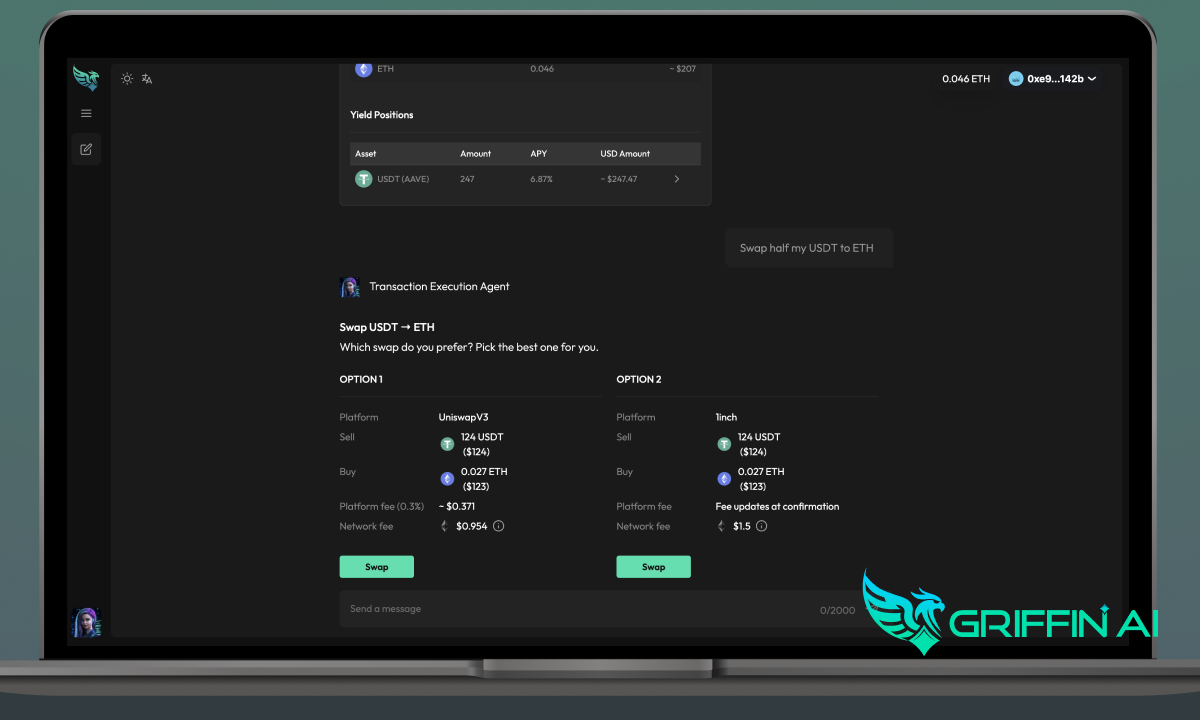
A swap in TEA Turbo
Let’s walk through a single example. Say you type: “Swap 50% of my USDT to ETH.”
TEA Turbo checks your wallet, fetches quotes from both Uniswap and 1inch, performs the math and sets out the details: which route it’s using, how much ETH you’ll receive, what the fees look like, and a slippage estimate.
Next, TEA Turbo shows the contract addresses, so you can double-check it all in detail. Then it hands you a ready-to-sign transaction. Tick, tick, tick…
You open MetaMask, WalletConnect, or Ledger, approve the transaction, and once it clears, the balances update right inside your chat window. Boom!
After a while, you notice how natural this back-and-forth starts to feel. You wonder how you could have done without it the week before.
You don’t have to remember the exact decimals of your balances any longer. You don’t have to click through three different interfaces just to see if you got the best route.
The interface has evolved into a hybrid. It’s still chat at the core, but tables and cards sit inside the flow. You can click on suggested assets, pools, or follow-up actions without typing long prompts. It feels like a dashboard that talks back rather than a chatbot LARPing as a dashboard.
Trust, control, and repetition of principles
From the beginning we built TEA Turbo to be non-custodial. The system absolutely cannot ever move funds without your explicit approval, and it does not hold any keys. That point bears repeating because it’s easy to confuse an execution agent with an autonomous agent.
TEA Turbo is not autonomous. It proposes, you approve. That safeguard model is as much about culture as it is about technology, and it keeps ownership firmly where it belongs.
We’ve circled back to this point throughout design and testing because it shapes how people think about using the agent. If you know it cannot act without you, you can really start to trust it as a helper. That’s the sweet spot for AI-assisted crypto transacting: assisted human autonomy.
It’s not everything: we know there are many other protocols and scenarios to cover, and we’ve got a lot more we’re almost ready to announce and roll out as part of TEA.
Griffin AI and TEA Turbo in the wider context
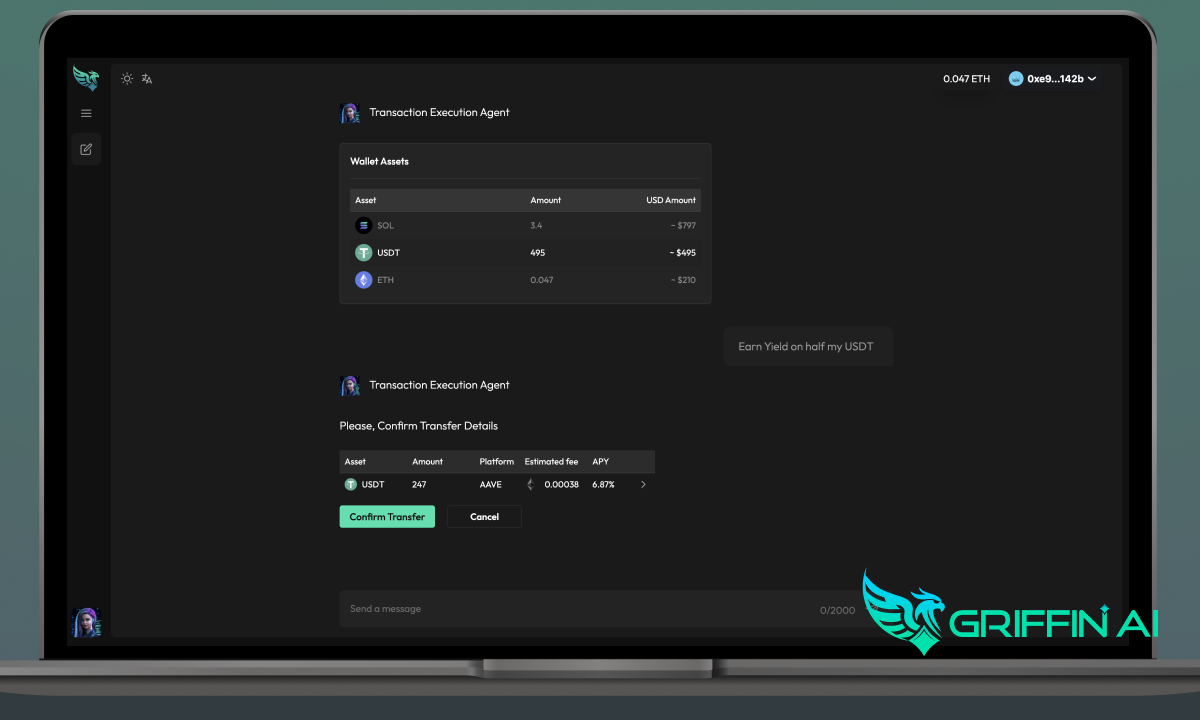
Earning yield with TEA Turbo
It’s worth pausing here to place this in context. Competitors like Warden Protocol, HeyAnon, and Bitte.ai are each exploring their own angles: more infrastructure, more developer tooling or on-chain automation.
Our focus in this major release has been measurable latency reduction, clarity of experience and direct execution in a way people use right now. The proposal-then-approval model gives us a foundation for agent-to-agent handoffs without breaking trust. When a research agent surfaces a promising yield, it can hand off to Turbo to prepare the transaction, and the user still signs at the end. That balance is key to the path we want to walk at Griffin AI.
Availability and what comes next
TEA Turbo is available now on Ethereum mainnet through the Griffin AI platform. It’s free to use, with only network and protocol fees applying. Over the next months we will expand to additional networks, add more DEX and aggregator venues, integrate further lending and yield protocols, and push into more advanced user scenarios.
This launch shows that agentic finance can make DeFi faster, more transparent and intuitive without losing the key safeguards. For our users, that means the everyday crypto actions can finally be handled in a flow that respects their time and control. This shows us that we’ve successfully laid the groundwork for the next stage. We’re so glad you’re here for it. Next time you want to transact on Ethereum, we hope you’ll take TEA Turbo for a fast-paced spin!
 Twitter
 Telegram
 Discord