Introduction: Scaling Trust in the Voltaire Era
With the arrival of the Voltaire era and the implementation of CIP-1694, Cardano has entered its most significant phase of decentralization. The community now holds the keys to the protocol, with the power to ratify hard forks, modify protocol parameters, and manage the treasury. But with this power comes a massive increase in cognitive load.
Governance at this scale is not just about voting; it is about understanding. A single parameter change proposal can have cascading effects on network security, decentralization, and economic incentives that are not immediately obvious from the proposal text alone. Expecting every Delegated Representative (DRep), Stake Pool Operator (SPO), and committee member to manually trace these deep systemic dependencies for every single proposal is a bottleneck that threatens to slow down decision-making or, worse, let critical errors slip through.
To solve this, we cannot rely on simple text summarization. We need an intelligent system capable of reasoning about the Cardano protocol itself.
Together with the Cardano Foundation we developed the Cardano Constitutional Examiner to serve as this decision-support layer. It is not a "black box" that tells you how to vote. Instead, it acts as a tireless, automated research analyst – one that parses the intent of a proposal, checks it against the immutable rules of the Constitution, and simulates its impact on the network’s health.
But how does an AI agent move beyond hallucination and accurately "understand" a blockchain constitution? It requires a new architecture – one that anchors the fluency of Large Language Models (LLMs) in the strict, deterministic logic of the Cardano protocol and its governance rules.
Here is how we built it.
Under the hood, the Cardano Constitutional Examiner is a hybrid-AI system that combines three pillars: a Large Language Model (LLM), a Cardano Governance Knowledge Graph, and a reasoning layer that ties them together into a single decision-support engine for on-chain governance.
1. From raw proposal to structured intent
Every proposal that enters the system is first normalized and decomposed into a structured internal representation. The Examiner:
- Ingests the proposal text (from on-chain payloads or off-chain drafts).
- Segments it into key components: objectives, rationale, mechanisms, parameter changes, and expected outcomes.
- Uses an LLM to extract entities such as governance roles (DReps, SPOs, Constitutional Committee), protocol parameters, time horizons, and affected subsystems (consensus, treasury, governance, etc.).
The result is a machine-readable profile of the proposal that captures not just the words, but the intent and levers of change.
2. Constitutional alignment via retrieval-augmented reasoning
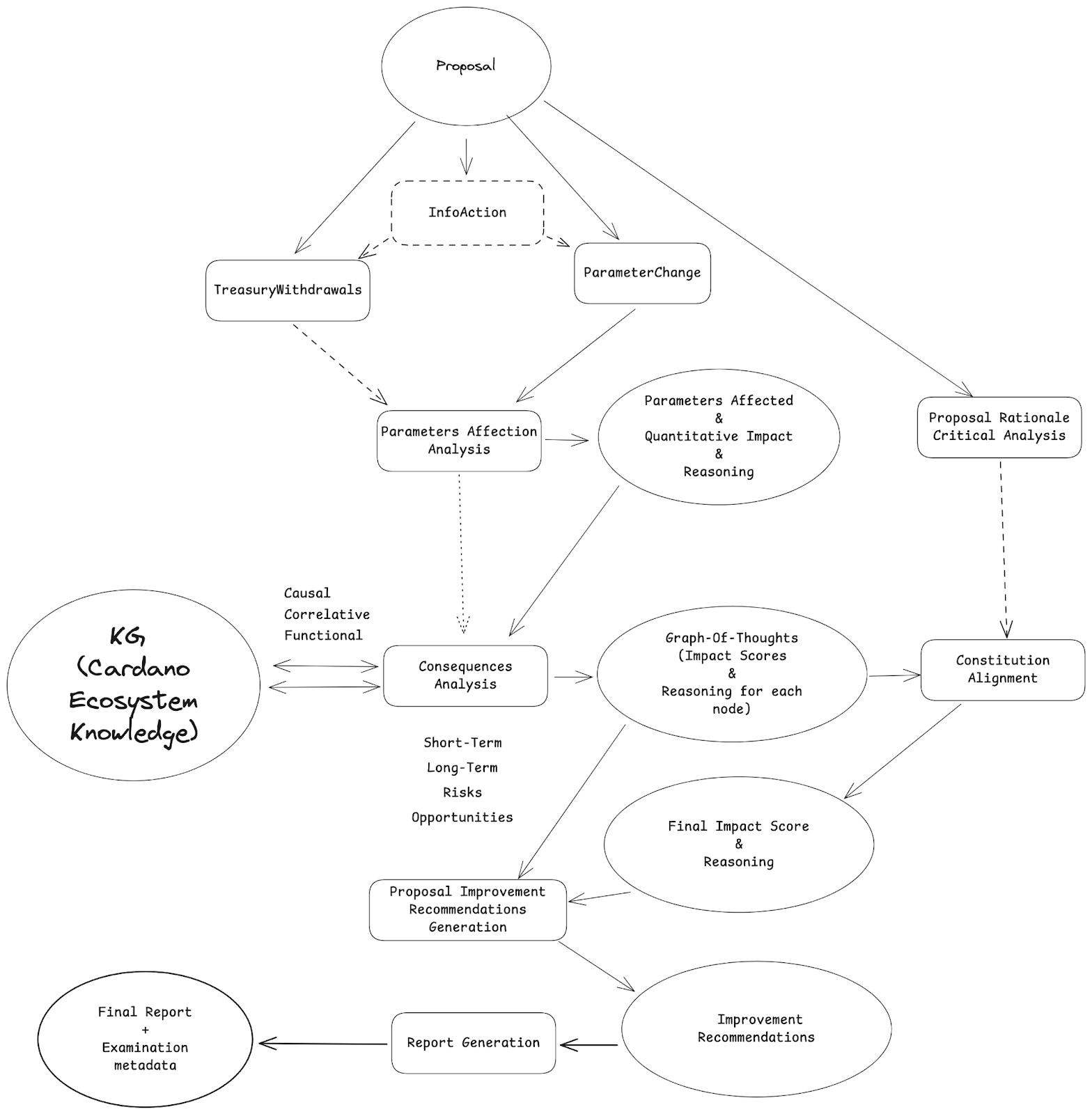
Figure 1 – End-to-end pipeline of the Cardano Constitutional Examiner, from proposal ingestion to final impact report.
Next, the Examiner evaluates alignment with the Cardano Constitution and other governance documents.
- A dedicated governance corpus (Constitution, CIPs, governance guidelines, Cardano Foundation documentation) is chunked, embedded, and indexed in a vector store for retrieval.
- The proposal’s key claims and actions are used to retrieve the most relevant constitutional articles and guidelines.
- The LLM then runs a set of prompts that compare the proposal against this retrieved context, checking for:
- Direct conflicts with constitutional clauses
- Hidden assumptions or loopholes
- Ambiguities that could enable future misuse
- Missing safeguards or accountability mechanisms
This produces a constitutional alignment report: a scored assessment plus natural-language explanations that cite the specific articles and sections involved, so reviewers can see why a risk or alignment flag was raised.
3. Governance Knowledge Graph: simulating systemic impact
Where the Examiner goes beyond standard RAG tooling is its Cardano Governance Knowledge Graph.
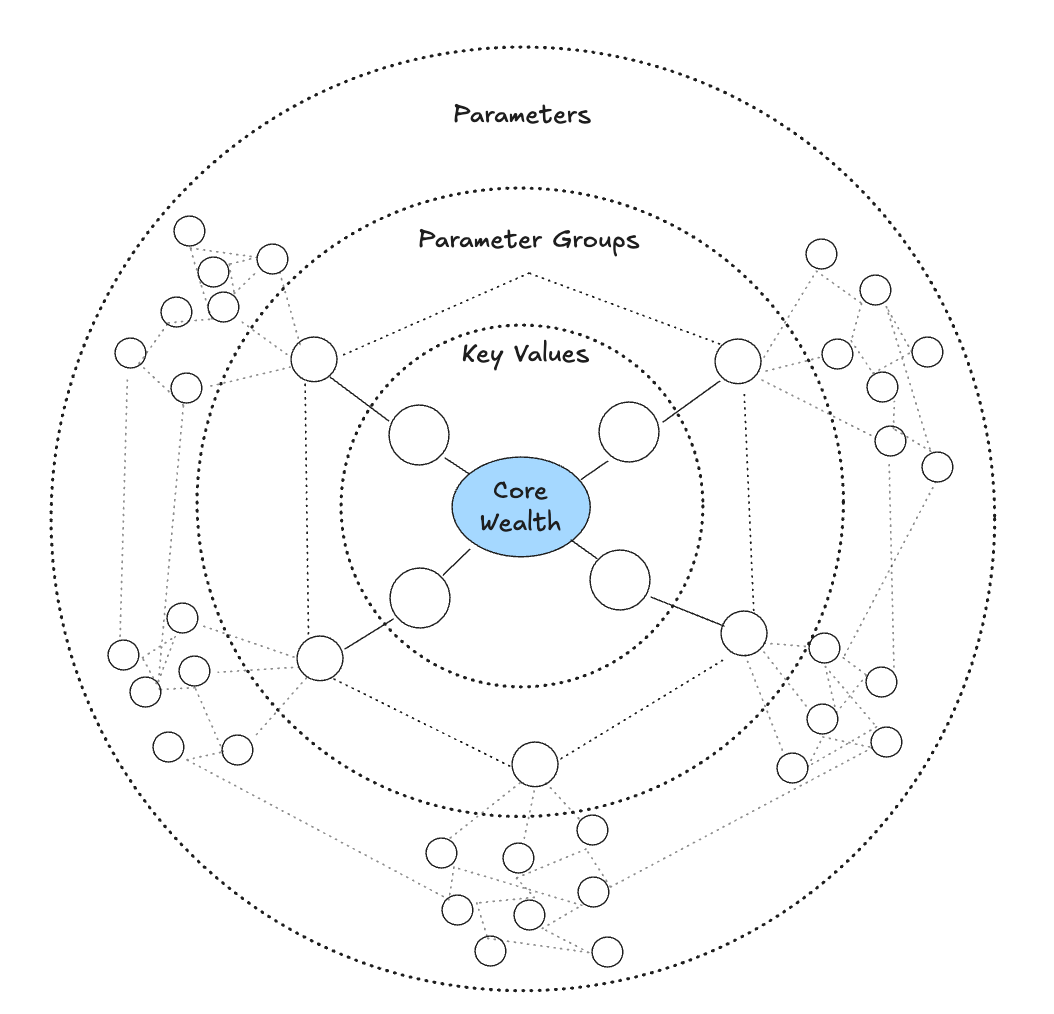
Figure 2 – Conceptual layers of the Cardano Governance Knowledge Graph: core wealth and values, parameter groups, and individual protocol parameters.
This graph encodes the relationships between:
- Protocol and governance parameters (e.g., quorum thresholds, voting periods, deposits, incentive settings)
- Higher-level indicators such as decentralization, governance resilience, network security, and ecosystem wealth distribution.
- (Planned) On-chain governance entities (DReps, SPOs, the Constitutional Committee, the treasury, etc.), allowing the graph to reason directly about institutional roles and power dynamics.
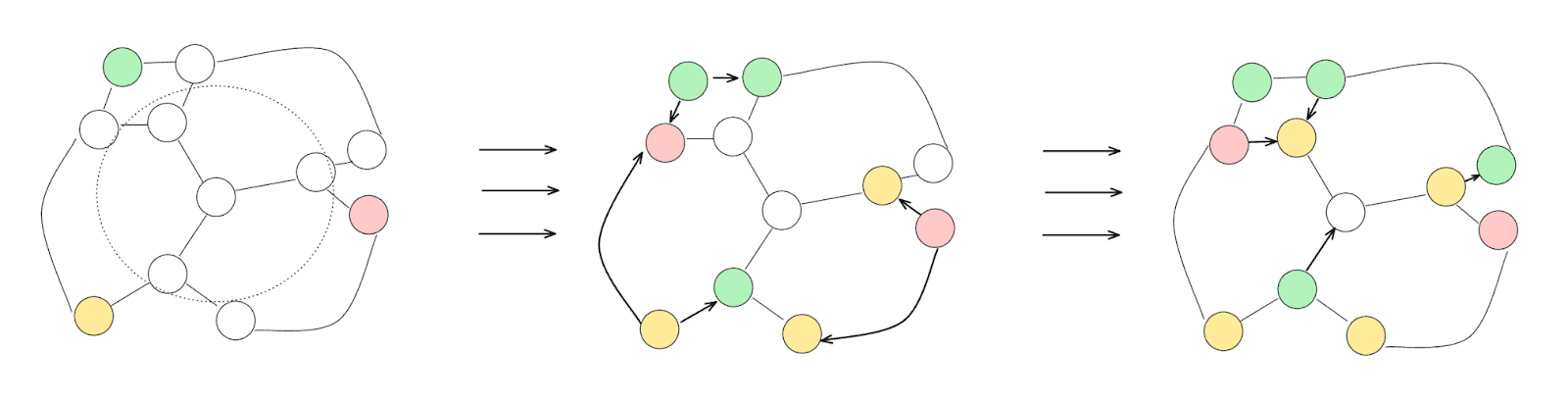
Figure 3 – Graph-of-Thoughts: the Examiner’s internal reasoning graph showing how parameter changes propagate and affect impact scores.
When a proposal touches any of these parameters or roles, the Examiner:
- Maps the proposed change onto the corresponding nodes in the graph.
- Propagates effects along edges that encode dependencies or causal links (e.g., “raising threshold X increases the effective power of Y, decreasing Z’s influence”).
- Aggregates impact signals to estimate how the proposal shifts key governance qualities:
- Does it increase or decrease the concentration of power?
- Does it make changes easier or harder to reverse?
- Does it strengthen or weaken checks and balances?
This graph-based reasoning allows the Examiner to simulate the systemic impact of parameter changes, not just quote rules. The output is a set of interpretable impact summaries (for example: “This change increases effective quorum for treasury withdrawals but may reduce practical participation of smaller DReps”).
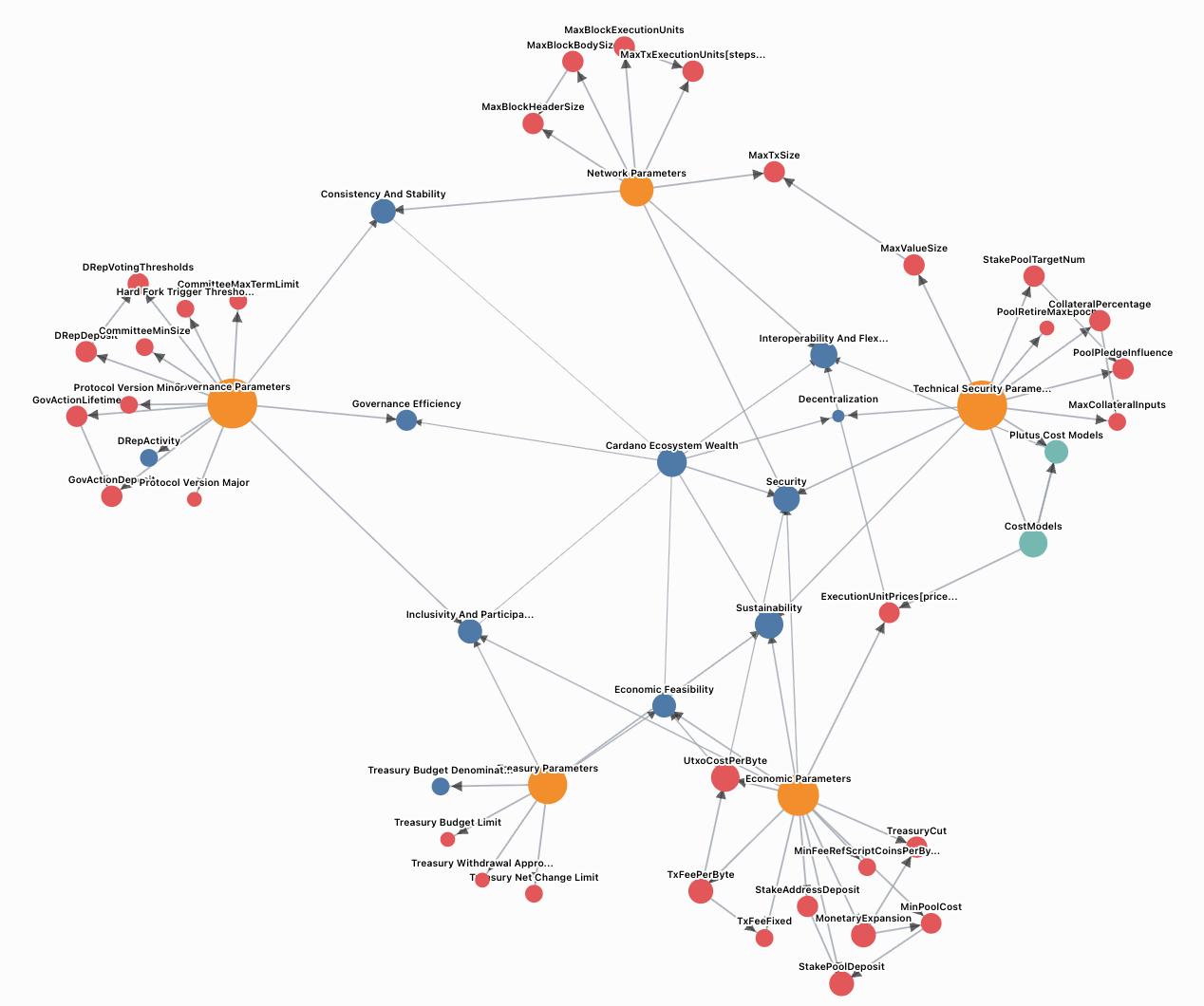
Figure 4 – Example slice of the Cardano Governance Knowledge Graph linking protocol parameters, governance indicators, and ecosystem outcomes.
As it runs this analysis, the Examiner also builds an internal Graph-of-Thoughts: a reasoning graph that links proposal clauses, retrieved constitutional articles, governance parameters, and intermediate conclusions. This makes the system’s reasoning path explicit and inspectable, so reviewers can see how each final assessment was formed.
4. Layered reasoning and scoring
The LLM and Knowledge Graph are orchestrated by a reasoning layer that runs multiple passes over the same proposal:
- A language-centric pass evaluates clarity, coherence of rationale, and motivational integrity (do arguments follow from stated goals, or are there hidden agendas?).
- A rule-centric pass focuses on strict compliance and edge cases (e.g., limits, thresholds, constitutional constraints).
- A system-centric pass uses the Knowledge Graph to examine second-order and third-order effects.
Internally, these passes are stitched together into the same Graph-of-Thoughts structure, where each node is a hypothesis or finding and each edge encodes a “because/affects/violates” relationship.
These passes are combined into a multi-dimensional scorecard for each proposal, including:
- Constitutional alignment
- Decentralization and power-distribution impact
- Governance process robustness
- Clarity and transparency of motivation
Each dimension is accompanied by bullet-point explanations and follow-up questions the community might want to ask the proposer.
5. Human-in-the-loop by design
Crucially, the Constitutional Examiner does not replace human governance. It is a decision-support agent designed for DReps, the Constitutional Committee, and the broader community:
- DReps can quickly understand the deep implications of complex proposals.
- The Constitutional Committee can check whether a proposal appears to violate the Constitution before escalation becomes necessary.
- Proposers can use the Examiner in “draft mode” to stress-test their ideas and refine them prior to submission.
By combining LLM-based semantic understanding, a governance-specific Knowledge Graph, and a transparent reasoning layer, the Constitutional Examiner sets a new bar for how AI can be safely and usefully deployed in high-stakes, decentralized governance – enhancing clarity and accountability while leaving final authority firmly in human hands.
 Twitter
 Telegram
 Discord